WhatsApp Marketing Strategy for Small Business: Your India Playbook
Master WhatsApp marketing for your small business in India. Discover 5 key steps to engage leads, automate follow-ups, and boost sales by 20% with practical, WhatsApp-first strategies.


For any small business owner in India, WhatsApp isn't just a messaging app; it's the lifeline for sales and customer engagement. To truly leverage it, you need a clear, automated WhatsApp marketing strategy that moves leads from interest to conversion. This playbook will guide you through setting up and executing a powerful WhatsApp strategy that works for the Indian market, focusing on timely follow-ups and seamless lead management.
Why WhatsApp is Non-Negotiable for Indian SMBs
Think about it: Almost every potential customer in India is on WhatsApp. They prefer it for quick communication, updates, and even making purchasing decisions. For your small business, this means WhatsApp isn't just a 'nice-to-have' channel; it's where your leads live, and where deals get done. Relying on calls or emails alone means you're missing out on a huge chunk of your market.
But it's not enough to just 'be on WhatsApp.' Dumping leads into a group chat or manually sending messages from a personal number is a recipe for chaos and missed opportunities. You need a structured, automated approach that respects customer privacy, scales with your business, and, most importantly, converts leads into paying customers.
Prerequisites for a Winning WhatsApp Strategy
Before you dive into sending messages, ensure you have these foundational elements in place:
- WhatsApp Business API Access: This is crucial. Forget the free WhatsApp Business App for anything serious. The API allows for automation, multiple users, CRM integration, and sending approved template messages at scale without getting banned. It’s what makes a strategy possible. OpsLoop offers a one-time ₹5,000 setup fee for WhatsApp Business (WABA) account setup, making this accessible.
- Explicit Opt-in Strategy: This is non-negotiable for compliance and avoiding spam reports. You need clear consent from users to send them messages. This could be through a checkbox on your website form, a WhatsApp click-to-chat button, or an IVR response.
- Pre-Approved Message Templates: WhatsApp requires certain types of outgoing messages (especially those not in response to a user-initiated conversation within 24 hours) to be pre-approved. These are structured messages for common use cases like lead follow-ups, payment reminders, or booking confirmations.
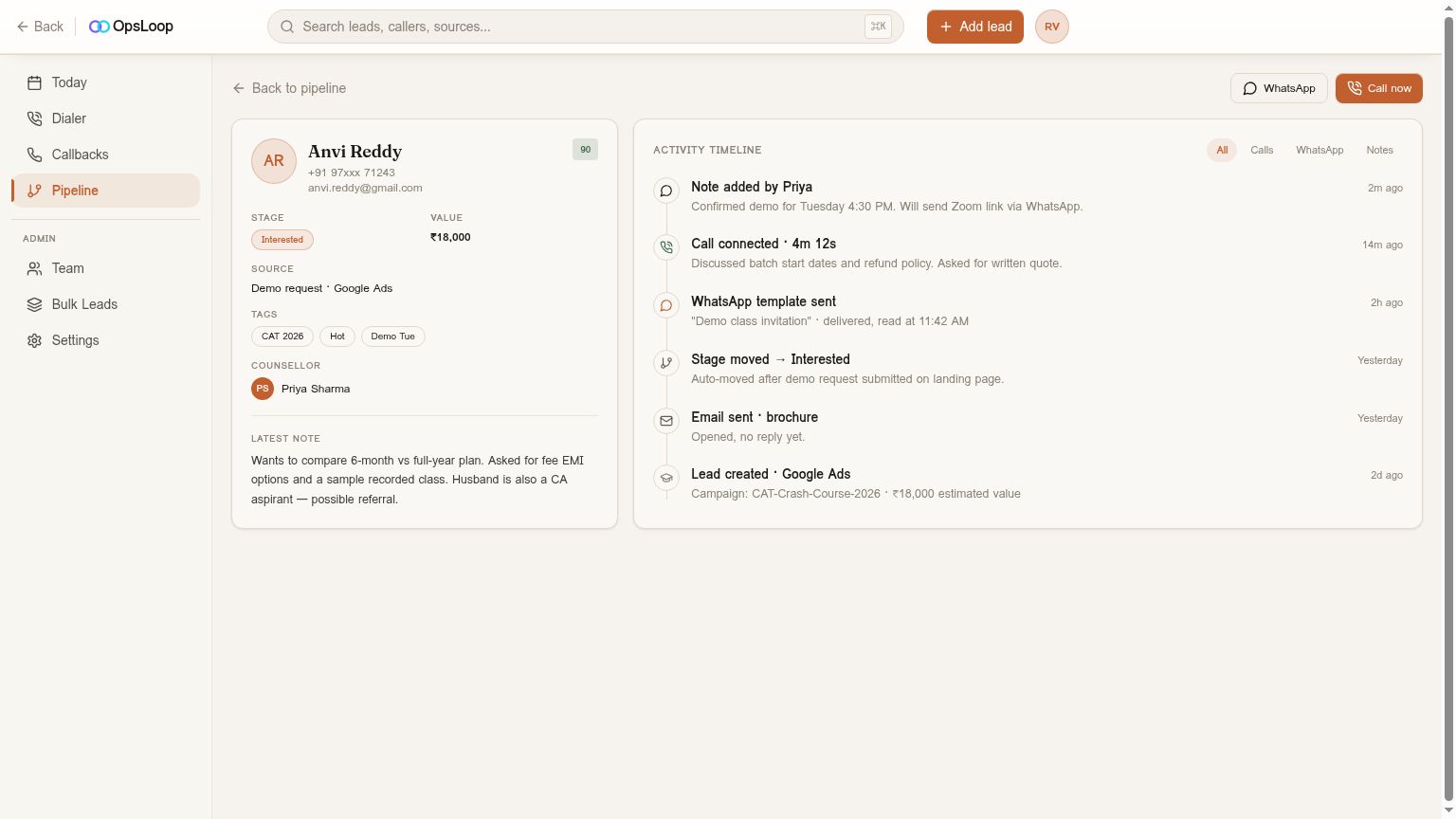
- A CRM with WhatsApp Integration: Manual lead management on WhatsApp is unsustainable. A CRM designed for WhatsApp leads, like OpsLoop, lets you manage all conversations in one inbox, automate follow-ups, track lead status, and measure performance. This is your command center.
Your 5-Step WhatsApp Marketing Playbook for Small Business
Step 1: Set Up Your WhatsApp Business API and Secure Opt-ins
This is your foundational step. Using the official WhatsApp Business API (WABA) is the only way to build a professional, scalable, and compliant WhatsApp marketing strategy. It allows you to:
- Handle high volumes: Manage hundreds or thousands of conversations simultaneously.
- Integrate with systems: Connect with your CRM, lead forms, and other tools.
- Automate: Send messages based on triggers without manual effort.
- Support multiple users: Your sales team can share one WhatsApp number and manage leads collaboratively.
How to get started:
- Partner with a Business Solution Provider (BSP): OpsLoop handles the WABA setup for you, including getting your number approved. This removes the technical headache.
- Implement clear opt-in points: Add a checkbox to your lead forms, use click-to-chat buttons on your website/ads, or clearly state that by engaging, they agree to receive WhatsApp messages. Ensure your privacy policy reflects this.
Step 2: Craft Compelling, Pre-Approved Message Templates
WhatsApp templates are your secret weapon for automated, proactive communication. They are pre-written messages approved by WhatsApp for common business use cases. Think beyond just "Hi." Focus on value, clarity, and a clear call to action.
Examples of effective templates for Indian SMBs:
- Initial Lead Response (within 5 minutes):
"Namaste {{1}}! Thank you for your interest in {{2}}. Our team is reviewing your request and will connect with you shortly. Meanwhile, you can explore our offerings here: {{3}}" - Follow-up After Demo/Call (24 hours later):
"Hi {{1}}, Hope you found our discussion on {{2}} helpful. Do you have any further questions or would you like to take the next step? Reply here, or call us at {{3}}." - Payment Reminder (3 days before due date):
"Dear {{1}}, Your payment for {{2}} (Invoice #{{3}}) of ₹{{4}} is due on {{5}}. Please make the payment here: {{6}} If already paid, please ignore." - Special Offer/Event Invitation:
"Hello {{1}}! We're excited to announce a special {{2}} for our valued customers. Get {{3}} off on {{4}}! Limited slots. Register now: {{5}}"
Remember to keep them concise, personal, and always include a call to action. For more ideas, check out our guide on WhatsApp Template Message Examples for Indian Businesses.
Step 3: Automate Your Follow-Up Sequences (The Real Engine)
This is where a WhatsApp marketing strategy truly shines for small businesses. Manual follow-ups are slow, inconsistent, and lead to massive lead leakage. Automation ensures every lead gets a timely, relevant message, dramatically increasing your chances of conversion. This is especially critical in India, where competition is fierce and leads go cold fast.
How to automate effectively:
- Instant Lead Response: As soon as a lead comes in from your website, Facebook/Google ads, or a landing page, an automated WhatsApp message should go out. This is critical because speed to lead statistics in India show that contacting a lead within 5 minutes can increase conversion by 9x.
- Multi-stage Follow-ups: Design a sequence of messages based on lead behavior. For example:
- Day 0: Instant welcome message + offer to connect.
- Day 1: Follow-up if no response, offering a specific resource or answering FAQs.
- Day 3: Gentle reminder or a value-add piece of content.
- Day 7: Last attempt message with a stronger CTA or a limited-time offer.
- Trigger-based Messages: Automate messages based on actions like:
- Demo booked: Send a confirmation and calendar invite.
- Payment incomplete: Send a reminder.
- Document pending: Send a checklist.
- Site visit scheduled: Send location and contact person details.
OpsLoop allows you to set up these automated WhatsApp follow-up sequences, ensuring no lead is ever left behind. Each message is sent using approved templates, maintaining compliance.
Step 4: Nurture Leads Beyond the First Sale
Your WhatsApp strategy shouldn't end once a lead converts. Post-sale engagement is vital for customer retention, repeat business, and referrals. For example, a coaching institute can send course updates, a real estate agent can share new property listings, or a lending business can offer renewal options.
Ideas for post-sale nurturing:
- Onboarding & Support: Send welcome messages, how-to guides, or customer support contacts.
- Feedback Requests: Ask for reviews or testimonials after a purchase or service completion.
- Loyalty Programs & Exclusive Offers: Share special discounts or early access to new products/services.
- Re-engagement Campaigns: If a customer hasn't interacted in a while, send a personalized message to bring them back.
Step 5: Track, Audit, and Optimize Your Performance
Without tracking, your WhatsApp marketing is just guesswork. A good CRM will give you insights into how your messages are performing. Look for:
- Delivery and Read Rates: Are your messages reaching and being opened?
- Response Rates: Are customers engaging with your messages?
- Conversion Rates: How many WhatsApp conversations lead to a sale or desired action?
- Lead Source ROI: Which channels are bringing in the most WhatsApp-ready leads?
OpsLoop's Owner Dashboard provides clear funnel and conversion metrics, and the Leak Audit feature alerts you to cold leads or missed follow-ups, allowing you to quickly identify and fix bottlenecks. Regularly review your message templates, automation timings, and overall strategy to continuously improve your results.
Gotchas: Don't X, Do Y with WhatsApp Marketing
To ensure your WhatsApp marketing strategy for small business thrives, avoid these common pitfalls:
-
DON'T: Treat WhatsApp like an email blast service. Sending unsolicited bulk messages to non-opted-in users is a sure-fire way to get blocked and potentially have your WABA account restricted. This is not how the API is designed to be used.
-
DO: Focus on personalization and value. Every message should feel like a 1:1 conversation, relevant to the recipient's journey. Offer solutions, information, or exclusive benefits.
-
DON'T: Rely on manual follow-ups for every lead. Your team will get overwhelmed, and leads will fall through the cracks. This leads to frustrated customers and lost revenue.
-
DO: Automate your follow-up sequences. Use a CRM that integrates with WhatsApp to send pre-approved messages based on triggers. This ensures consistency and speed, crucial for converting leads.
-
DON'T: Use a personal WhatsApp number or the free WhatsApp Business App for your entire sales ops. It lacks critical features like multi-user access, automation, and integration with other business tools.
-
DO: Invest in the WhatsApp Business API and a dedicated CRM for WhatsApp Leads. This is the only way to scale your operations, maintain professionalism, and protect your business identity.
-
DON'T: Ignore your data. Sending messages without tracking their impact is a waste of time and money.
-
DO: Regularly audit your performance. Look at open rates, response rates, and conversion metrics. Use these insights to refine your message templates, timings, and overall strategy.
What Good Looks Like: Benchmarks for Your Indian Small Business
While exact numbers vary by industry and product, a well-executed WhatsApp marketing strategy for small business in India can yield impressive results:
- Message Open Rates: Aim for 80-95%. WhatsApp messages have significantly higher open rates than email due to their immediate nature.
- Response Rates: Expect 20-40% for well-targeted, personalized messages with clear CTAs. This can be much higher for instant lead responses.
- Lead-to-Conversion Rate (from WhatsApp): A robust strategy can see 10-25% of engaged WhatsApp leads convert into paying customers, depending on your sales cycle and product value.
- Follow-up Time: Strive for a 60-second enquiry-to-call SLA or an instant automated WhatsApp response. Speed is paramount in the Indian market.
These benchmarks are achievable with a structured approach and the right tools. For example, coaching institutes using OpsLoop often see a +34% demo show-up rate by automating their WhatsApp follow-ups and reminders. This translates directly to more admissions and higher revenue. Businesses in industries like coaching, real estate, and lending are already seeing these benefits by adopting a WhatsApp-first approach. If you're looking for tools to help, explore our guide to the Best WhatsApp Marketing Tools in India (2026 Guide).
Key Stats
- 60 seconds: The ideal time to respond to a new lead via WhatsApp or call.
- 80-95%: Typical open rates for WhatsApp messages.
- ₹5,000: One-time setup fee for OpsLoop, including WABA and automation setup.
- 34%: Increase in demo show-up rates for businesses using automated WhatsApp follow-ups.
Ready to transform your lead management and sales with a powerful WhatsApp marketing strategy? Stop losing leads to manual follow-ups and embrace the power of automation.
Further reading
FAQ
Frequently asked
Is WhatsApp marketing legal for small businesses in India?
Yes, WhatsApp marketing is legal in India if you use the official WhatsApp Business API and obtain explicit opt-in consent from your customers before sending messages. This ensures compliance and respects user privacy.
How much does WhatsApp marketing cost for a small business?
The cost varies. It includes per-conversation charges from WhatsApp (after free tiers), platform fees for a WhatsApp Business API provider or CRM, and a one-time setup fee (e.g., ₹5,000 for OpsLoop). Costs are usage-based for messages and AI calls.
Can I use the regular WhatsApp Business App for marketing?
The WhatsApp Business App is suitable for very small businesses with low message volumes and one user. However, for automation, multiple users, tracking, and scalability, the WhatsApp Business API is essential. The App has limitations on broadcasts and integrations.
What kind of messages work best for WhatsApp marketing in India?
Personalized, value-driven messages tend to perform best. This includes quick lead responses, relevant offers, payment reminders, booking confirmations, document checklists, and proactive follow-ups tailored to the customer's journey.
How can I automate WhatsApp follow-ups for my leads?
You can automate WhatsApp follow-ups by integrating the WhatsApp Business API with a CRM like OpsLoop. This allows you to set up trigger-based sequences that send pre-approved template messages automatically at specific stages of the lead journey or after certain actions.
What's the biggest mistake small businesses make with WhatsApp marketing?
A common mistake is treating WhatsApp like a bulk broadcast channel without proper opt-ins, leading to user blocks and account restrictions. Another is relying on manual follow-ups, which causes delays and lead leakage, especially critical in the Indian market.
READ NEXT
WhatsApp Drip Campaign Setup: Your Indian SMB Playbook
Learn to set up effective WhatsApp drip campaigns for your Indian business in 5 steps. Improve lead conversions by up to…
How to Get Green Tick on WhatsApp Business in India (2026 Guide)
Want the official WhatsApp Green Tick for your business in India? Follow 7 clear steps to verify your brand, boost trust…
How to Increase Coaching Admissions: A 5-Step Playbook for India
Boost coaching admissions by up to 30% with this 5-step playbook. Learn to capture leads faster and convert more enquiri…
Try OpsLoop free for 14 days
Flat team plans from ₹3,000/month. No per-seat fees. No card to start.