CRM for WhatsApp Leads in India: Your Complete Guide
Discover how a CRM for WhatsApp leads can boost your sales by 30% and stop lead leakage. This guide covers setup, best practices, and pricing for Indian businesses.


For Indian businesses, WhatsApp isn't just another messaging app; it’s often the first point of contact for new leads. A CRM for WhatsApp leads is a specialised system that captures, organises, and nurtures these enquiries, turning casual chats into confirmed sales. It centralises your WhatsApp communications, automates crucial follow-ups, and provides a clear view of your sales pipeline, ensuring no lead is ever missed or forgotten. This guide will walk you through why this is critical for your business, how it works, and how to implement it effectively.
Why a WhatsApp CRM Matters for Your Indian Business (The ₹ Math)
In India, WhatsApp is ubiquitous. From a small shop owner in Tier 2 cities to large coaching institutes, everyone communicates on WhatsApp. This makes it an incredibly powerful, yet often chaotic, source of leads. Without a proper system, these leads often slip through the cracks, costing you real money.
Consider this: You spend ₹500 on ads to generate one lead. If your team is managing these leads manually on personal WhatsApp numbers, here’s what typically happens:
- Delayed Responses: A lead messages you at 7 PM. Your sales person sees it next morning. The lead has already enquired with 3 competitors.
- Lost Context: The lead talks to Person A, then Person B. Neither knows the full history, forcing the customer to repeat themselves.
- No Follow-up: A lead shows interest but doesn't convert immediately. Without a system, they're forgotten, and your ad spend on them is wasted.
- No Visibility: As an owner, you have no idea how many WhatsApp leads came in, how many were followed up, or what your conversion rate is.
This isn't just inconvenient; it's a direct leak in your revenue pipeline. If you generate 100 leads a month at ₹500 each (₹50,000 ad spend), and even 30% of them are lost due to poor WhatsApp management, you're essentially throwing away ₹15,000 in ad spend and the potential revenue from those 30 customers. A dedicated WhatsApp CRM stops this leak, ensuring every lead gets the attention it deserves and moves through your sales process efficiently.
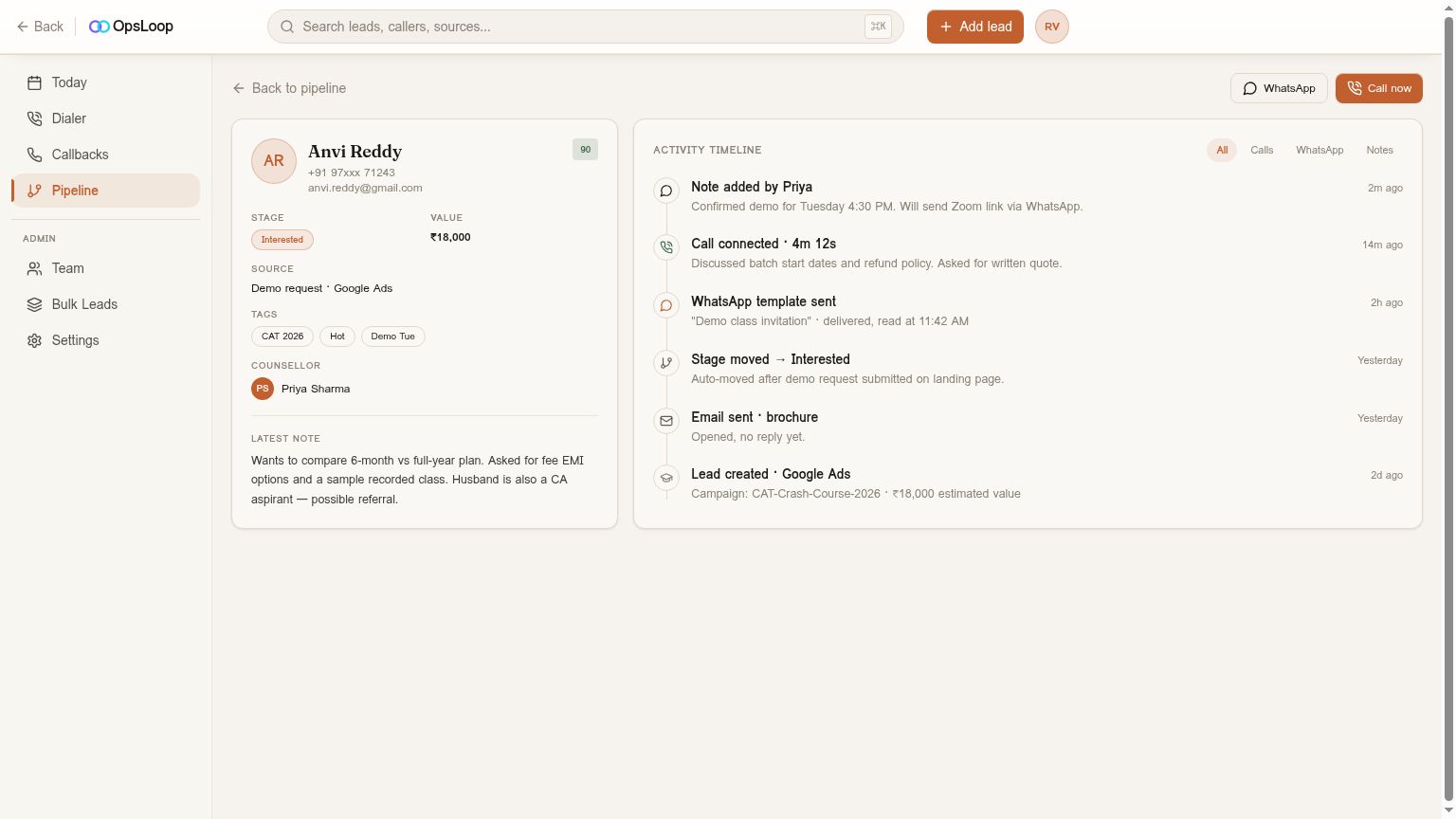
How a CRM for WhatsApp Leads Works
A CRM designed for WhatsApp leads acts as a central nervous system for your sales operations. It brings structure and automation to a channel often dominated by informal chats. Here’s a breakdown of its core functionalities:
1. Unified Inbox for All WhatsApp Chats
Instead of scattered conversations on individual phones, all incoming WhatsApp messages from leads land in a single, shared inbox. This means:
- No Missed Enquiries: Every new lead is instantly visible to the sales team, reducing the chances of a lead going cold.
- Shared Context: Any team member can pick up a conversation, seeing the full chat history, internal notes, and activity timeline. This eliminates the need for customers to repeat themselves.
- Multi-channel View: Many CRMs, like OpsLoop, also integrate email (Gmail) and automatically log calls alongside WhatsApp chats, creating a complete communication history for each lead in one place.
2. Automated Follow-up Sequences
This is where a WhatsApp CRM truly shines. Manual follow-ups are inconsistent and time-consuming. With automation, you can:
- Instant Replies: Send automated welcome messages, share brochures, or ask initial qualification questions as soon as a lead messages. This ensures immediate engagement, critical for lead conversion.
- Drip Campaigns: Set up sequences of messages (e.g., reminders, value-adds, next steps) to be sent over days or weeks, nurturing leads without manual effort. OpsLoop offers pre-approved templates for quick setup.
- Event-Triggered Messages: Automatically send messages based on lead actions, such as a demo booked, a document shared, or a specific stage in the pipeline.
3. Lead Tracking and Pipeline Management
A WhatsApp CRM provides a clear, visual pipeline to track every lead's journey. You can:
- Assign Leads: Automatically or manually assign new WhatsApp leads to the right sales agent.
- Track Stages: Move leads through customisable stages (e.g., New Enquiry, Qualified, Demo Booked, Negotiation, Won/Lost) using a simple drag-and-drop interface.
- Update Status: Log outcomes of calls, messages, and meetings, ensuring the lead record is always current.
4. Team Collaboration and Efficiency Tools
For growing teams, collaboration is key. A WhatsApp CRM facilitates this with features like:
- Shared Notes: Agents can add internal notes to lead profiles, visible to the whole team, ensuring everyone is on the same page.
- @Mentions: Tag team members for quick collaboration or to hand over a lead.
- Auto-dialer: For businesses that combine WhatsApp with calling, an integrated auto-dialer (like OpsLoop’s one-tap dial) ensures calls are made efficiently and outcomes are logged automatically.
5. Leak Audit and Owner Dashboard
For business owners, visibility is paramount. A good WhatsApp CRM provides insights into your sales operations:
- Leak Audit: Features like OpsLoop's 'Leak Audit' actively alert owners to cold leads, missed callbacks, or leads stuck in a stage, preventing revenue from slipping away unnoticed.
- Owner Dashboard: Get a bird's-eye view of your sales funnel, conversion rates, sales rep performance, and ROI from different lead sources. This empowers you to make data-driven decisions.
Choosing the Right CRM for WhatsApp Leads in India
With several options available, picking the right CRM for WhatsApp leads requires careful consideration, especially for the Indian market. Here's what to look for:
1. Pricing Model: Flat vs. Per-Seat vs. Hybrid
This is perhaps the most critical factor for Indian SMBs. Many CRMs, like Zoho CRM or LeadSquared, charge per-user/per-seat. While they might seem affordable initially, these costs quickly add up as your team grows. For example, if Zoho CRM's Professional plan costs ₹2,100/user/mo, a team of 10 sales agents would pay ₹21,000/month just for the CRM, not including WhatsApp message charges.
Some WhatsApp marketing tools like WATI or Interakt use a hybrid model, charging a base fee plus additional costs per agent or per marketing message. This can lead to unpredictable bills, especially if your lead volume fluctuates.
Look for a CRM with flat-rate pricing per business, like OpsLoop. This means you pay a fixed amount, regardless of how many sales agents you have, making your operational costs predictable and encouraging team growth without penalty. This is a significant advantage, as explored in detail in our article on flat pricing math.
2. Deep WhatsApp Integration
Ensure the CRM fully leverages the WhatsApp Business API, not just a basic integration. This includes:
- Approved template management for official communications.
- Two-way messaging with full chat history in the CRM.
- Automated sequences and broadcasts.
- Ability to send rich media (images, documents) seamlessly.
3. India-Specific Features and Support
- GST Invoicing: Essential for compliance.
- Local Payment Gateways: Integration with common Indian payment methods.
- DPDP Compliance: Adherence to India's data protection laws.
- Local Support: Timely assistance in your time zone, ideally within 24 hours.
4. Ease of Setup and Use
You don't want a complex implementation project. Look for CRMs that promise quick setup, ideally live in 1 day with pre-built industry templates. OpsLoop, for instance, focuses on being operational quickly, so you can start converting leads immediately.
5. Beyond WhatsApp: Core CRM Capabilities
While WhatsApp integration is key, ensure the CRM offers robust core features for complete lead management:
- Pipeline Management: Customisable stages for your specific sales process.
- Auto-dialer: For integrated calling workflows.
- Email Sync: To consolidate all communication.
- Reporting & Analytics: To track performance and identify bottlenecks.
Step-by-Step: Implementing Your WhatsApp CRM Effectively
Bringing a CRM for WhatsApp leads into your business isn't just about software; it's about process. Here's a checklist for a smooth rollout:
- Define Your Sales Process: Before you even log in, map out your current lead-to-sale journey. What are the stages? What actions happen at each stage? This will guide your CRM setup.
- Integrate WhatsApp API: Follow the CRM's instructions to connect your WhatsApp Business API account. This is usually straightforward with the right CRM partner.
- Set Up Pipelines and Stages: Configure your CRM with custom pipeline stages that mirror your defined sales process. For a coaching institute, this might be 'New Enquiry', 'Counselling Scheduled', 'Demo Attended', 'Fee Discussion', 'Enrolled'. You can find more specific guidance for your sector on our industries page for coaching.
- Create WhatsApp Templates and Sequences: Design your automated messages. Start with a welcome message, then build a nurturing sequence for leads who don't respond immediately. Ensure these templates are approved by Meta for Business API use.
- Train Your Team: Conduct thorough training sessions. Show them how to use the unified inbox, assign leads, log activities, use automation, and update lead statuses. Emphasise the benefits for them (less manual work, higher commissions).
- Migrate Existing Leads (If Any): If you have existing WhatsApp chats or spreadsheets, import them into the CRM to ensure a complete historical record.
- Monitor, Analyse, and Refine: Regularly review your owner dashboard. Look at conversion rates, response times, and lead source performance. Use OpsLoop's 'Leak Audit' reports to identify where leads are dropping off and refine your processes and automated sequences accordingly.
Common Mistakes to Avoid with WhatsApp Lead Management
Even with a powerful CRM, certain pitfalls can derail your WhatsApp lead conversion efforts:
- Using Personal WhatsApp Numbers: This is the biggest mistake. It leads to lost leads, lack of transparency, and poor customer experience. Always use the official WhatsApp Business API integrated with your CRM.
- Delayed Responses: Indian customers expect near-instant replies on WhatsApp. Automate your initial response to acknowledge the enquiry and set expectations, even if a human agent follows up later. Every minute counts.
- Lack of Structure: Treating WhatsApp like a casual chat. Without a pipeline, lead assignments, and clear follow-up rules, your team will quickly fall back into chaos, regardless of the CRM.
- Ignoring Analytics: Not tracking which messages work, which sources generate the best leads, or why leads are getting stuck. The data in your CRM is gold – use it to improve.
- Over-Automating without Personalisation: While automation is crucial, avoid robotic, generic messages. Use templates that allow for personalisation (e.g., lead's name, specific enquiry details) to maintain a human touch.
- Not Having a Clear CTA: Every conversation should have a purpose. Guide the lead towards the next step, whether it's a call, a demo, a brochure download, or a payment link.
Key Stats
- +34% demo show-up rate (coaching case study using OpsLoop)
- 60-second enquiry-to-call SLA achievable with proper CRM automation.
- Live in 1 day – OpsLoop setup time, meaning faster ROI.
- ₹15,000+ monthly ad spend can be wasted by losing just 30% of 100 leads at ₹500 CPL.
Implementing a robust CRM for WhatsApp leads is no longer a luxury but a necessity for any Indian business serious about growth. It transforms a chaotic lead source into a predictable, high-converting sales engine. By centralising communication, automating follow-ups, and providing clear visibility, you ensure every rupee spent on ads translates into maximum possible revenue.
Ready to stop leaking WhatsApp leads and boost your conversions?
Further reading
FAQ
Frequently asked
What is a CRM for WhatsApp leads?
A CRM for WhatsApp leads is a customer relationship management system specifically designed to capture, manage, and nurture sales leads generated through WhatsApp. It integrates WhatsApp conversations directly into your sales pipeline, allowing for automated follow-ups, lead tracking, and team collaboration.
Why is a WhatsApp CRM important for Indian businesses?
WhatsApp is the most popular communication channel in India. Many leads come through it. A WhatsApp CRM ensures that these leads are not lost in personal chats, are followed up promptly, and their entire journey from enquiry to sale is tracked, leading to higher conversion rates and better ROI on ad spend.
What features should I look for in a CRM for WhatsApp leads?
Key features include a unified inbox for all WhatsApp chats, automated WhatsApp follow-up sequences, lead pipeline management, auto-dialer, shared notes, and analytics dashboards. For India, look for flat pricing (not per-seat) and local support.
Can I use the WhatsApp Business App as a CRM?
The WhatsApp Business App is good for very small businesses with low lead volumes (1-2 people). For growing teams or higher lead volumes, it lacks lead tracking, team collaboration, automation, and reporting features essential for managing leads effectively. A dedicated CRM is necessary to scale.
How does a WhatsApp CRM help with lead leakage?
A WhatsApp CRM prevents lead leakage by ensuring every enquiry is captured, assigned, and followed up automatically. Features like 'Leak Audit' (in OpsLoop) alert owners to cold leads or missed callbacks, ensuring no potential customer falls through the cracks due to manual oversight.
What is the typical pricing model for WhatsApp CRMs in India?
Pricing models vary. Some charge per-user, which scales with your team. Others, like OpsLoop, offer flat-rate pricing per business, with unlimited users. There are also hybrid models that charge per-message or per-contact on top of a base fee. Flat-rate models are generally more predictable for growing teams.
READ NEXT
WhatsApp Shared Team Inbox India: Your 2026 Guide
Boost your Indian business's lead response by 30% with a WhatsApp shared team inbox. Streamline communication, prevent l…
WhatsApp Conversation Pricing Meta 2026: Your India Guide
Understand Meta's WhatsApp conversation pricing for Indian businesses in 2026. Learn how 4 message categories impact cos…
WATI Pricing in India (2026): A Complete Guide for SMBs
Understand WATI's pricing in India for 2026, from its ₹4,100 base plan to per-message costs. Learn how to calculate tota…
Try OpsLoop free for 14 days
Flat team plans from ₹3,000/month. No per-seat fees. No card to start.