WhatsApp Shared Team Inbox India: Your 2026 Guide
Boost your Indian business's lead response by 30% with a WhatsApp shared team inbox. Streamline communication, prevent lead leakage, and improve conversions. Discover setup steps.


For Indian businesses, WhatsApp isn't just another messaging app; it's often the first touchpoint for a new lead or an existing customer. A WhatsApp shared team inbox centralizes all these crucial conversations into one place, enabling multiple team members to manage and respond from a single business number. This setup drastically improves lead response times and customer service, directly impacting your conversion rates and operational efficiency.
Why a WhatsApp Shared Team Inbox Matters for Your Indian Business
Imagine a potential customer sends an inquiry via WhatsApp about your coaching classes, a real estate property, or a loan product. If that message lands in a single salesperson's phone, what happens if they're on a call, out of office, or simply busy with another client? The lead waits. And waits. In India, where speed is paramount, that delay costs you money.
According to recent data, the first few minutes after an inquiry are critical. Missing that window can mean losing the lead entirely. This is where a shared WhatsApp team inbox steps in. It transforms your WhatsApp from a personal communication tool into a powerful, collaborative lead management system. Here's why it's not just a 'nice-to-have' but a 'must-have' for Indian SMBs:
- Stop Lead Leakage: Individual WhatsApp numbers are black holes for leads. Messages get lost, forgotten, or simply aren't seen by the right person. A shared inbox ensures every single inquiry is logged, visible, and assigned to a team member, drastically cutting down on missed opportunities. This directly addresses the problem of lead leakage: what it is and how to stop it.
- Boost Speed-to-Lead: When multiple agents can access and respond to incoming messages, your response time plummets. This is vital because speed to lead statistics in India consistently show that faster responses lead to significantly higher conversion rates. A lead contacted within 5 minutes is far more likely to convert than one contacted after an hour. For a coaching institute, this could mean the difference between filling a batch and losing students to a competitor.
- Improve Team Collaboration: Your sales or admissions team no longer operates in silos. With internal notes, assignment features, and a complete chat history, everyone has context. A team member can pick up where another left off, ensuring a seamless customer experience even if the original agent is unavailable or on leave. This eliminates the chaos of multiple personal devices and ensures continuity.
- Consistent Customer Experience: Standardized responses, approved templates, and a unified view of customer interactions ensure that every customer receives consistent, high-quality service, regardless of who they're talking to. This professionalism builds trust and strengthens your brand reputation.
- Scalability: As your business grows and you add more sales or support staff, a shared inbox scales with you. You don't need new WhatsApp numbers or complicated forwarding rules; you simply add more agents to your existing system, making onboarding new team members much smoother.
Understanding How a WhatsApp Shared Team Inbox Works
At its core, a WhatsApp shared team inbox leverages the WhatsApp Business API (WABA). This is different from the regular WhatsApp Business App. While the app is free and great for small businesses with one or two users, it lacks the multi-user, multi-device, and automation capabilities needed for a true shared inbox. For a deep dive, read our guide on WhatsApp Business API vs App.
Here’s a breakdown of the typical workflow:
- Centralized Inbox: All messages sent to your official WhatsApp Business number land in a single, web-based inbox. This inbox is accessible by your entire team, creating a single source of truth for all customer communications.
- Lead Assignment: New messages can be manually assigned to a specific agent, or automatically routed based on predefined rules (e.g., round-robin, lead source, time of day). This ensures accountability and prevents messages from sitting unread.
- Collaborative Tools: Agents can see who is responding to a chat, add internal notes for context (e.g., "customer asked for a callback tomorrow"), or even transfer a conversation to another team member if needed. This prevents duplicate responses and ensures continuity, even across shifts.
- Quick Replies & Templates: Pre-approved message templates and quick replies help agents respond faster and maintain brand consistency. These are especially useful for common queries, FAQs, or initial greetings, saving valuable time and ensuring compliance.
- Automation: Many shared inbox solutions integrate with CRMs to allow for automated follow-up sequences, welcome messages, or even lead qualification chatbots. This frees up your team to focus on high-value conversations.
- Analytics: Business owners and managers get a complete overview of team performance, response times, conversation volumes, and lead conversion rates, helping them identify bottlenecks and optimize processes for better results.
Options for Your Shared Inbox: Dedicated Platforms vs. CRM Integration
When choosing a WhatsApp shared team inbox solution for your Indian business, you'll generally encounter two main categories:
1. Dedicated WhatsApp Messaging Platforms
These tools focus primarily on WhatsApp (and sometimes other social media) communication. They are designed for robust messaging, broadcasting, and chatbot functionalities.
- Strengths: Often excel at managing high volumes of WhatsApp messages, offer detailed campaign management, and provide specialized chatbot builders. Tools like Interakt, WATI, and AiSensy fall into this category, offering features like unified inboxes and campaign managers.
- Weaknesses: While strong on messaging, they often lack comprehensive CRM features. This means you might need to integrate them with a separate CRM for full lead tracking, pipeline management, and sales automation. Many also operate on a hybrid pricing model with per-message or per-agent costs on top of a base plan. For instance, Interakt charges ₹499/mo per agent and Meta template charges (₹1.09 marketing), while WATI has high base pricing (starting ₹4,100/mo) plus per-seat and conversation charges.
2. CRM with Native WhatsApp Integration
This is often the most comprehensive solution for lead-driven businesses, especially in India. A CRM (Customer Relationship Management) system that has WhatsApp built in allows you to manage leads, track their journey, automate follow-ups, and handle all WhatsApp conversations from a single platform.
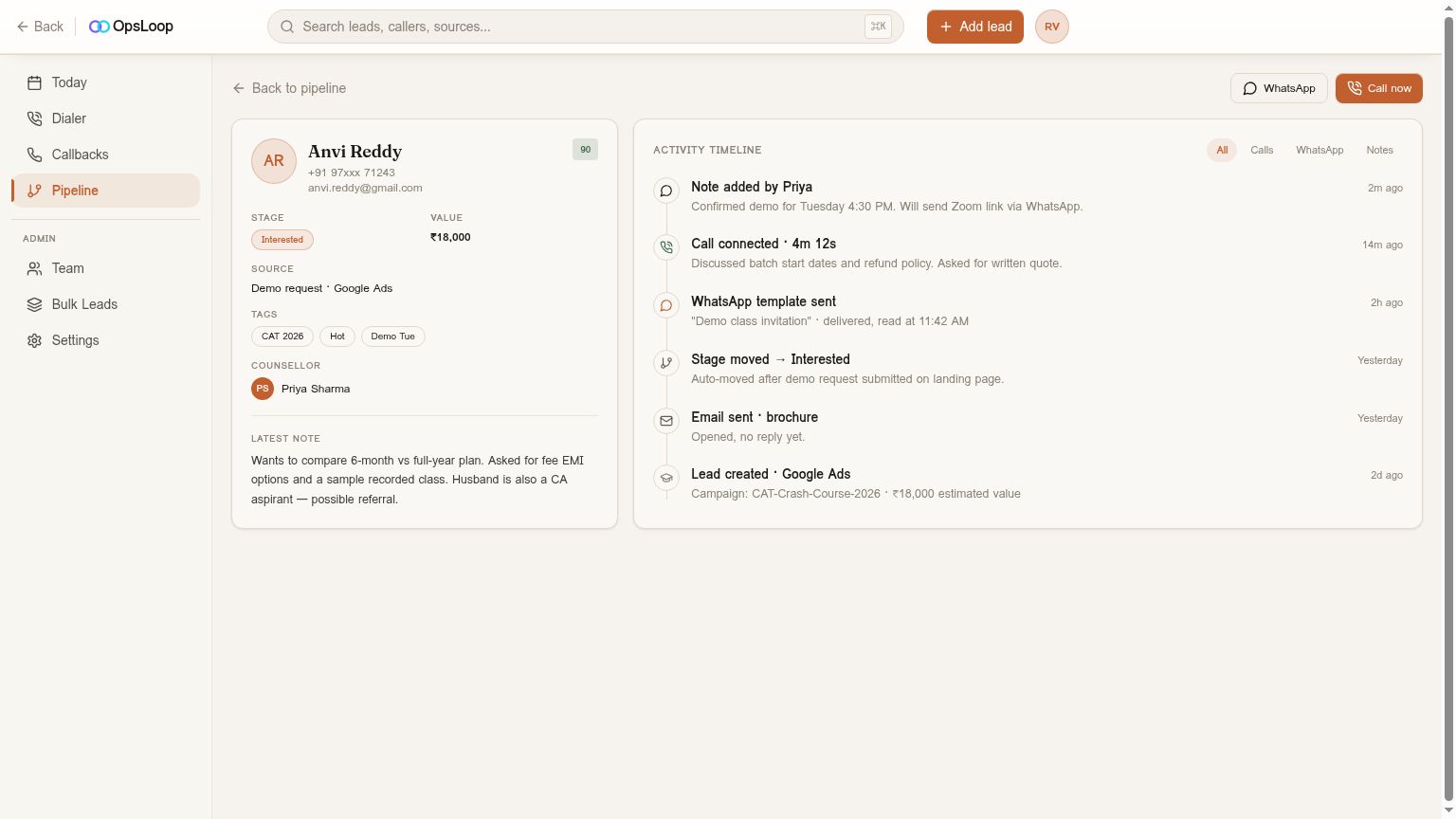
- Strengths: Provides an end-to-end view of the customer journey, from initial inquiry to sale and beyond. All lead data, communication history (calls, emails, WhatsApp), and pipeline stages are in one place. This eliminates data silos and reduces manual data entry. For example, OpsLoop (Disclosure: OpsLoop is our product) offers a "One Inbox" that syncs email, logs calls, and integrates WhatsApp, all within a flat-rate CRM designed for Indian businesses. This means features like approved WhatsApp templates, auto follow-up sequences, and reply-thread context are all built-in. Plus, with flat pricing per team-size band, you avoid per-seat or per-message charges for the core platform, helping you manage costs as your team grows. You can explore our pricing plans here.
- Weaknesses: While excellent for lead-to-sale operations, they might not have every niche WhatsApp marketing feature (e.g., advanced bulk broadcasting for purely promotional content) that a dedicated messaging platform might offer. However, for core lead management and sales follow-up, they are often superior.
Key Features to Look For in an Indian WhatsApp Shared Inbox Solution
Choosing the right solution requires a clear understanding of your business needs. Here are critical features to prioritize:
- Unified Communication Inbox: Beyond just WhatsApp, does it centralize all lead communications? This includes calls, emails (like Gmail sync), and internal notes, providing a complete activity timeline for every lead. This is what we refer to as a "One Inbox" approach.
- Lead Management & Pipeline: A true shared inbox isn't just for chatting; it should help you move leads through your sales funnel. Look for features like custom pipeline stages, lead assignment, and the ability to track lead status directly from the chat.
- Automation Capabilities: Can it automate initial greetings, follow-up sequences, or lead qualification based on WhatsApp interactions? This is crucial for maintaining
speed to leadand ensuring consistent engagement without manual effort. - Team Collaboration Tools: Internal notes, chat transfer, and visibility into who is handling which conversation are non-negotiable for seamless teamwork and preventing duplicate efforts.
- Performance Analytics: The system should provide dashboards and reports on key metrics like response times, conversation volumes, agent performance, and lead conversion rates. This helps owners identify bottlenecks and optimize their sales process.
- India-Specific Focus & Support: Look for platforms designed for the Indian market, offering INR pricing, GST invoicing, and local support. A platform built with Indian business workflows in mind will always be a better fit. For instance, OpsLoop is made in India, DPDP compliant, backed by enterprise-grade security, and offers priority support that resolves tickets within an hour.
Common Mistakes to Avoid with Your WhatsApp Shared Team Inbox
Implementing a shared inbox can transform your operations, but watch out for these pitfalls:
- Not Training Your Team: A new tool is only as good as the team using it. Ensure thorough training on how to use the inbox, assign leads, use templates, and collaborate effectively.
- Failing to Set Clear Assignment Rules: Without clear rules, messages can still go unassigned or be handled by multiple agents, leading to confusion. Define who handles what, when, and how.
- Ignoring Performance Metrics: The analytics dashboard isn't just for show. Regularly review response times, conversion rates, and agent activity to identify areas for improvement. This helps you understand your team's efficiency, especially for critical functions like admission CRM for coaching classes.
- Using the WhatsApp Business App for a Growing Team: As discussed, the basic app is not built for team collaboration. Trying to force it for multiple users will only lead to chaos and missed leads.
- Not Integrating with Your CRM: If you're using a dedicated messaging platform, ensure it's tightly integrated with your CRM. Otherwise, you'll have fragmented data and your team will waste time switching between systems.
Key Stats: The Bottom Line for Indian Businesses
Implementing a WhatsApp shared team inbox, especially one integrated with a CRM, delivers tangible results:
- 30% faster lead response times: Leads contacted within minutes are significantly more likely to convert.
- 20-40% reduction in lead leakage: Every inquiry gets seen, assigned, and followed up on.
- Improved team efficiency: Agents spend less time managing individual chats and more time engaging with qualified leads.
- Higher conversion rates: Faster, more consistent follow-up directly translates to more closed deals, whether it's for an EdTech company ensuring every trial signup is called while hot or a real estate business following up on every site visit.
Ready to transform your lead management and customer communication? A WhatsApp shared team inbox is a foundational step for any Indian business serious about growth. See how a platform like OpsLoop can centralize your WhatsApp leads, automate follow-ups, and help you fill every batch before intake date, like for a coaching institute.
Further reading
- WhatsApp Drip Campaign Setup: Your Indian SMB Playbook
- WhatsApp Conversation Pricing Meta 2026: Your India Guide
- WhatsApp CRM: The Best Tools in India for 2026 (Pricing)
- WATI Pricing in India (2026): A Complete Guide for SMBs
Start your 14-day free trial of OpsLoop today – no card required. Start free trial
FAQ
Frequently asked
What is a WhatsApp shared team inbox?
A WhatsApp shared team inbox allows multiple agents or sales reps to manage and respond to customer conversations coming into a single WhatsApp Business number. It centralizes all chats, enabling collaboration, lead assignment, and full visibility over customer interactions.
Why is a WhatsApp shared team inbox crucial for Indian businesses?
In India, WhatsApp is often the first point of contact for leads and customers. A shared inbox ensures no inquiry is missed, responses are fast, and team members can collaborate on conversations, directly addressing lead leakage and slow follow-up, which are common issues for Indian SMBs.
Can I use the regular WhatsApp Business App for a shared inbox?
No, the standard WhatsApp Business App is designed for a single user or a very small team using multiple devices, which often leads to chaos and missed messages. A true WhatsApp shared team inbox requires the WhatsApp Business API, integrated with a CRM or dedicated messaging platform, to handle multiple agents and advanced features.
What features should I look for in a WhatsApp shared team inbox solution?
Look for features like centralized chat history, lead assignment, internal notes for team collaboration, automation capabilities (auto-replies, follow-up sequences), performance analytics, and integration with your existing CRM or lead management system. India-specific features like local support and INR pricing are also beneficial.
How does a shared WhatsApp inbox help prevent lead leakage?
By centralizing all incoming messages, a shared inbox ensures that every lead is seen and assigned, reducing the chances of messages getting lost in individual inboxes. Faster response times and consistent follow-ups, often automated, also significantly reduce the likelihood of leads going cold before conversion.
What's the difference between a dedicated WhatsApp platform and a CRM with native WhatsApp?
Dedicated WhatsApp platforms like Interakt or WATI excel at messaging and campaigns but may lack deep CRM functionalities. A CRM with native WhatsApp, like OpsLoop, offers end-to-end lead management, pipeline tracking, and sales automation alongside integrated WhatsApp communication, providing a unified view of the customer journey from inquiry to conversion.
READ NEXT
WhatsApp Conversation Pricing Meta 2026: Your India Guide
Understand Meta's WhatsApp conversation pricing for Indian businesses in 2026. Learn how 4 message categories impact cos…
WATI Pricing in India (2026): A Complete Guide for SMBs
Understand WATI's pricing in India for 2026, from its ₹4,100 base plan to per-message costs. Learn how to calculate tota…
Interakt Pricing Review: Understanding Costs for Indian SMBs (2026)
Get a clear Interakt pricing review for 2026. Understand the hybrid model, per-message costs, and how 3 key factors impa…
Try OpsLoop free for 14 days
Flat team plans from ₹3,000/month. No per-seat fees. No card to start.