Lead Leakage: What it is & How to Stop It in Your Indian Business
Lead leakage costs Indian businesses up to 40% of potential sales. Learn what causes it and 5 practical steps to plug these revenue drains.


You’re running ads, getting enquiries, and your team is busy. But are those leads actually turning into customers? If you’re feeling like you’re constantly chasing your tail, pouring money into marketing only for a fraction of leads to convert, you’re likely battling lead leakage. It’s the silent drain on your revenue, where potential customers slip through the cracks of your sales process, costing Indian businesses untold lakhs every year.
Lead leakage is simply the invisible loss of potential customers at various stages of your sales funnel. It means that the leads you’re paying good money to acquire aren't getting the attention they need, or they're getting lost in the shuffle, ultimately failing to convert into paying customers. The good news is, by understanding where these leaks occur and implementing a systematic approach, you can plug them and significantly boost your conversion rates and ad ROI.
The Silent Drain: Are You Losing Money Without Knowing It?
Imagine filling a bucket with water, but it has tiny holes. No matter how much water you pour in, it never fills up completely. That’s what lead leakage feels like. You’re spending on Meta ads, Google ads, getting website enquiries, and WhatsApp messages, but your sales numbers aren't climbing as they should. It's frustrating, and often, you don't even know where the water is escaping.
For many Indian business owners, this isn't just a hypothetical problem; it's a daily reality. The symptom isn't always a sudden collapse, but a slow, persistent drip that erodes profitability and makes growth feel like an uphill battle. Let's look at the common ways leads leak and what that actually costs you.
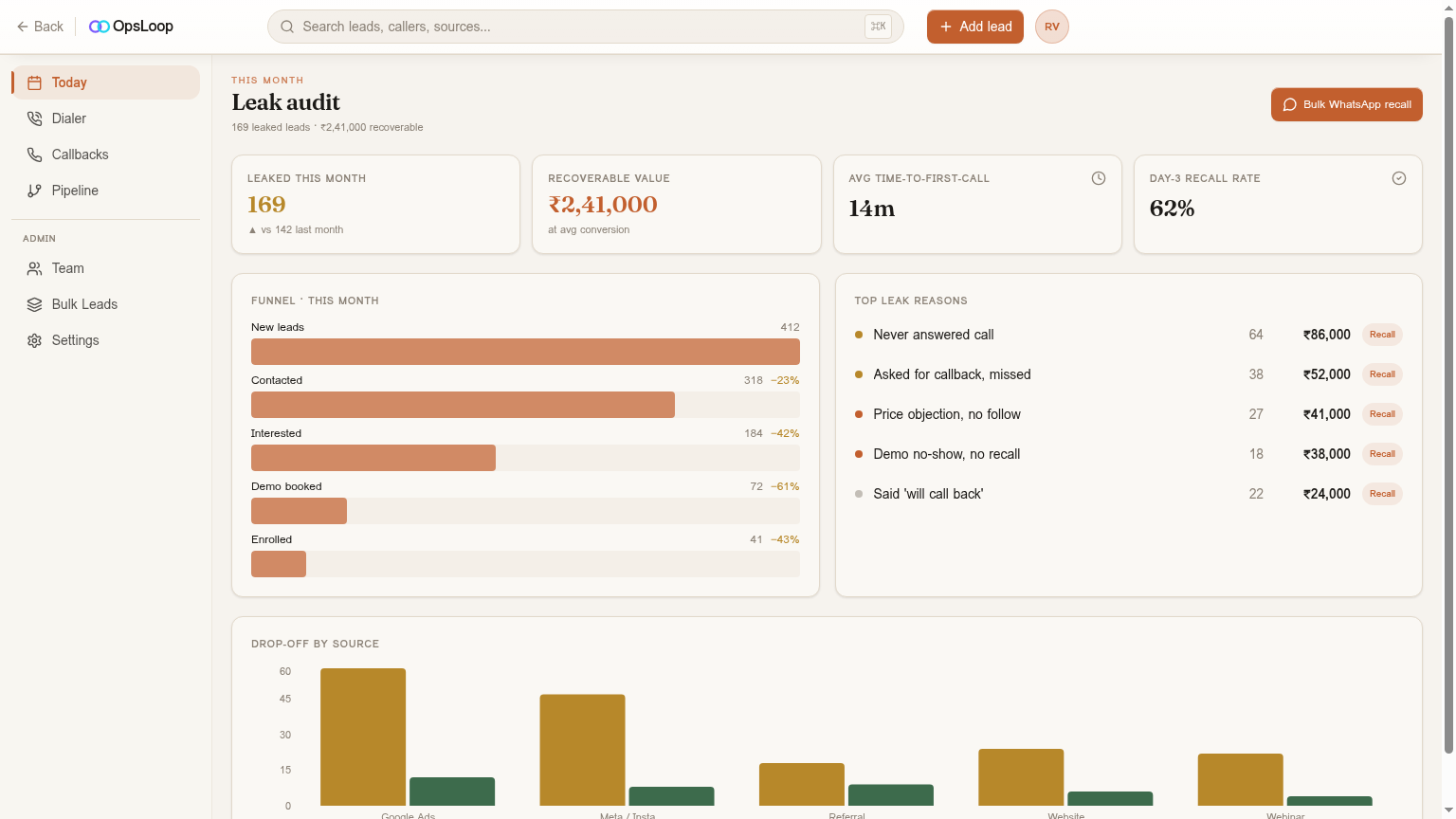
Symptoms & Their Real Costs in ₹
Symptom 1: Slow or Missed Follow-Ups – The Cold Lead Tax
Every minute counts when a lead comes in. In India's competitive market, potential customers are often enquiring with multiple businesses simultaneously. If you don't respond quickly, someone else will. A lead that's hot at 10 AM can be ice cold by 2 PM.
The Cost: This is a direct hit to your ad spend ROI. If you pay ₹400 for a lead, and it goes cold because of a 3-hour delay in calling or messaging, that ₹400 is effectively wasted. Studies consistently show that the odds of qualifying a lead drop dramatically after the first hour. Our own data, across OpsLoop workspaces, often shows a significant drop in engagement if leads aren't contacted within 48 hours. This phenomenon is so critical, we've explored it in detail in our article on The 48-Hour Window: Why Coaching Leads Go Cold So Fast.
Symptom 2: Leads Disappearing into the Cracks – The Data Black Hole
Where do your leads live? Are they in a spreadsheet? In a sales rep's personal WhatsApp chat? Scrawled in a notebook? The more dispersed your lead data, the higher the chance of leads getting forgotten, duplicated, or simply lost. This is especially true with the WhatsApp-first nature of Indian business communication.
The Cost: Each lost lead is a missed opportunity for revenue. If your average sale is ₹20,000, losing just five leads a month due to disorganization costs you ₹1 lakh. Beyond that, you lose valuable context. When a lead calls back, does your team know who they are, what they discussed, or what stage they're in? Without this, every interaction starts from scratch, frustrating the customer and making your team look unprofessional. We see this problem frequently, as highlighted in our blog about Running a ₹50 Lakh Business on 14 WhatsApp Groups.
Symptom 3: No Clear Picture of Your Sales Funnel – The Blind Spot
As a business owner, can you tell at a glance how many leads are currently in the 'demo scheduled' stage? Or how many proposals are out? If your answer involves asking multiple team members or sifting through complex spreadsheets, you have a blind spot. Without a clear view of your sales funnel, you can't identify bottlenecks, coach your team effectively, or forecast revenue accurately.
The Cost: This lack of visibility prevents proactive problem-solving. You can't fix what you can't see. If 80% of your leads are dropping off after the first call, but you don't know it, you can't adjust your script or training. This also impacts your ability to optimize your ad spend. You might be pouring money into channels that bring in high volumes but low-quality leads, without even realizing it. Understanding your true lead enrollment conversion rate is critical, yet often overlooked.
The Root Cause: Your System, Not Your Staff
It’s easy to blame individual sales reps for missed follow-ups or lost leads. But more often than not, the problem isn't a lack of effort; it's a lack of a robust system. When your team relies on manual processes, personal WhatsApp, or basic spreadsheets, they are set up to fail. These tools simply aren't designed to handle the volume and complexity of modern lead management.
- Reliance on personal WhatsApp: Great for individual conversations, terrible for team collaboration and tracking. Conversations are siloed, and if a rep leaves, their lead history often goes with them.
- Fragmented communication: Leads come from Meta, Google, website forms, direct calls. Without a central inbox, managing these different channels becomes a logistical nightmare.
- Lack of automation: Manually scheduling follow-ups, sending reminders, or updating lead statuses is time-consuming and prone to human error, especially when dealing with hundreds of leads.
- No accountability framework: Without a system that tracks every interaction and flags missed steps, it's impossible to hold team members accountable or provide targeted coaching.
The Solution Path: Plugging the Leaks with a Smart System
Stopping lead leakage isn't about working harder; it's about working smarter with the right tools. The key is to implement a centralized, automated, and India-focused lead management system. Here’s how:
Step 1: Centralize Every Lead, Immediately
Your first goal should be to capture every single lead, regardless of its source, into one unified system. Whether it's a Meta ad form submission, a Google Ads call, a website chat, or a direct WhatsApp message, it needs to land in a single inbox that your entire team can access.
- How it helps: No lead gets missed. No more checking multiple platforms. Instant visibility for the whole team.
Step 2: Automate First-Touch Follow-Ups
Speed is king. The moment a lead comes in, an automated first-touch response should be triggered. This could be an instant WhatsApp message acknowledging their inquiry and letting them know when to expect a call.
- How it helps: Engages the lead while they're hot, sets expectations, and buys your team precious time to connect personally. OpsLoop, for example, allows you to set up immediate WhatsApp auto-replies using approved templates.
Step 3: Standardize Follow-Up Sequences with WhatsApp
Beyond the first touch, you need a systematic approach to nurturing leads. This means pre-defined follow-up sequences that ensure no lead is forgotten. This is where a CRM with deep WhatsApp integration truly shines in India.
- How it helps: Your team gets prompts for calls, SMS, or WhatsApp messages. Pre-approved WhatsApp templates ensure consistent messaging. Leads are moved through your pipeline with a clear next step, whether it's scheduling a demo for a coaching institute or sending a document checklist for a lending business. For practical examples, check our guide on WhatsApp Follow-Up Messages to Customer: Indian Playbook.
Step 4: Gain Visibility & Accountability with Leak Audits
As an owner, you need to know exactly what's happening in your sales funnel. A good system provides dashboards that show lead status, team performance, and conversion rates at every stage. Crucially, it should also highlight where leads are getting stuck or dropping off.
- How it helps: OpsLoop's 'Leak Audit' feature, for instance, sends weekly digests directly to owners, flagging cold leads, missed callbacks, and pipeline bottlenecks. This empowers you to address issues proactively, coach your team effectively, and make data-driven decisions about your marketing spend. This level of insight is what truly transforms CRM for Small Business in India from a simple database to a growth engine.
Step 5: Pick the Right Tool for India
Not all CRMs are created equal, especially for the Indian market. Look for a solution built with India's unique challenges and opportunities in mind:
- WhatsApp-first: Seamless integration for automated sequences and 1:1 communication.
- Flat pricing: Avoid per-user costs that penalize growth. OpsLoop offers flat pricing per business, allowing you to scale your team without increasing your CRM bill.
- Ease of use: No complex implementation projects. You should be able to go live in days, not months.
- Local support: Responsive support that understands your context and language.
Consider a platform like OpsLoop, which is designed specifically for Indian businesses, offering features like a unified inbox, auto-dialer, and pre-built pipelines for various industries like lending.
What Changes When You Stop the Leakage
When you effectively plug lead leakage, the transformation in your business is immediate and tangible:
- Higher Conversion Rates: More of your hard-earned leads turn into paying customers.
- Improved Ad Spend ROI: Every rupee you spend on marketing works harder, generating more revenue.
- Predictable Revenue Growth: With a clear, managed sales funnel, forecasting and achieving your revenue targets becomes much more reliable.
- Reduced Stress & Chaos: Your team is more organized, productive, and less overwhelmed, leading to a better working environment.
- Clear Visibility: You, as the owner, have a real-time pulse on your sales operations, empowering you to make informed decisions.
Key Stats
- +34% demo show-up rate (seen in coaching case studies using systematic follow-ups)
- 60-second enquiry-to-call SLA (achievable with instant lead routing)
- Live in 1 day (typical setup time for industry-specific CRMs like OpsLoop)
Don't let your valuable leads slip away. It's time to stop the invisible drain on your profits and build a robust system that ensures every lead gets the attention it deserves. Your business, your team, and your bank account will thank you.
Ready to see how a flat-rate, WhatsApp-first CRM can plug your lead leaks and drive growth?
Further reading
FAQ
Frequently asked
What exactly is lead leakage?
Lead leakage refers to the loss of potential customers (leads) at various stages of your sales process, from initial inquiry to final conversion. This can happen due to slow follow-ups, misplaced contact information, or inadequate nurturing, leading to wasted marketing spend and lost revenue.
How much does lead leakage typically cost Indian businesses?
While exact figures vary, many Indian businesses unknowingly lose a significant portion of their potential sales, often 30-40%, due to lead leakage. This translates directly to wasted ad spend and missed revenue opportunities, especially in competitive markets.
What are the primary causes of lead leakage in Indian SMBs?
Key causes include delayed or inconsistent follow-ups, leads scattered across personal WhatsApp chats, spreadsheets, or notebooks, lack of a centralized system to track lead progress, poor lead qualification, and insufficient visibility into sales team activities and conversion rates.
Can WhatsApp leads contribute to lead leakage?
Yes, paradoxically, while WhatsApp is a primary communication channel in India, managing leads solely through individual WhatsApp Business accounts or group chats is a major source of leakage. Leads get lost, follow-ups are forgotten, and data isn't centralized, making it impossible to track or hand over effectively.
How can a CRM system help stop lead leakage?
A CRM designed for Indian operations, like OpsLoop, centralizes all lead inquiries from various sources (Meta, Google, WhatsApp), automates instant follow-ups, standardizes communication sequences, and provides a clear view of your sales pipeline. This ensures no lead is forgotten, improving accountability and conversion rates.
Is lead leakage a problem for small businesses or mostly large enterprises?
Lead leakage is a critical problem for businesses of all sizes, but it often hits small and medium-sized businesses (SMBs) harder in India. With tighter budgets and smaller teams, every lost lead represents a more significant portion of potential revenue and a larger waste of precious marketing spend.
READ NEXT
99acres Leads Not Converting? Fix Your Real Estate Pipeline
Many real estate brokers struggle when 99acres leads are not converting. Discover 3 common leaks and fix your follow-up …
Why Coaching Institutes Are the Last to Automate (And Why That's Your Advantage)
Every other industry automated ops years ago. Education lagged behind. Here's why 2025-26 is your inflection point—and h…
Fee Collection Is a Marketing Problem, Not an Admin Problem
Every rupee you spend on Facebook ads becomes worthless when fee friction kills student LTV. Automate collection or watc…
Try OpsLoop free for 14 days
Flat team plans from ₹3,000/month. No per-seat fees. No card to start.