WhatsApp Follow-Up Messages to Customer: Indian Playbook
See 34% higher demo show-ups with effective WhatsApp follow-up messages. Learn proven strategies for Indian businesses to convert leads faster and reduce ghosting.


A well-timed WhatsApp follow-up message to a customer can be the difference between a lost lead and a closed sale for Indian businesses. In a market where speed and personal connection matter most, leveraging WhatsApp for consistent, relevant communication helps you nurture leads, answer queries, and guide them through their buying journey effectively.
Why WhatsApp Follow-Ups Are Non-Negotiable for Indian Businesses
In India, WhatsApp isn't just an app; it's how business gets done. From family conversations to vendor negotiations, it's the default communication channel. For your business, this means your sales and operations teams need to master WhatsApp follow-ups to stay competitive and convert more leads.
The "Missed Call" Mentality: Speed and Personalization
Indian customers expect quick responses. If they've enquired about your service or product, they are actively looking for a solution now. A delayed follow-up, even by a few hours, can mean they've moved on to a competitor. WhatsApp allows for instant, personal engagement, mimicking the immediacy of a phone call but with the added benefit of sharing rich media like brochures, price lists, or demo videos.
The Cost of a Cold Lead: ₹ Math
Consider this: if you spend ₹500 to acquire a new lead through Meta or Google Ads, and your follow-up system is weak, a significant portion of those leads will go cold. If 60% of your leads drop off due to poor follow-up, you're essentially wasting ₹300 on every acquired lead that doesn't convert. This translates to lakhs of rupees in lost revenue annually. A robust WhatsApp follow-up strategy can significantly boost your conversion rates, ensuring every lead you pay for has the best chance to become a paying customer. In fact, businesses using effective follow-up systems often see a significant uplift, such as a +34% demo show-up rate in coaching institutes, directly impacting their bottom line.
WhatsApp's Dominance: Everyone's on It
With hundreds of millions of users in India, WhatsApp offers unparalleled reach. Your customers are already on the platform, making it frictionless to connect with them. Unlike emails that get lost in spam or calls that go unanswered, a WhatsApp message often gets seen and responded to quickly, especially if it's timely and relevant. This ubiquity makes it the most effective channel for ongoing customer communication and lead nurturing.
Crafting Effective WhatsApp Follow-Up Messages: Principles
Simply sending a message isn't enough. The content, tone, and timing of your WhatsApp follow-up message to customer must be strategic. Here are the core principles:
- Be Prompt, Be Personal, Be Concise: Speed is paramount. Address the customer by name and keep your message to the point. Long paragraphs get ignored.
- Value-Driven, Not Salesy: Focus on providing value, answering questions, or offering solutions, rather than aggressively pushing a sale. Build trust first.
- Clear Call to Action (CTA): Every message should have a single, clear next step. Do you want them to book a demo? Download a brochure? Reply to a question?
- Use Templates, But Personalize: Have approved templates ready for common scenarios, but always customize them with specific details relevant to the customer's previous interaction.
- Maintain Context: Refer back to their previous enquiry or conversation. This shows you remember them and aren't sending generic messages.
WhatsApp Follow-Up Message Templates for Common Scenarios
Here are some templates tailored for the Indian market, designed to be effective and professional. Remember to adapt these to your specific business and customer interactions.
Scenario 1: Initial Enquiry (Hot Lead)
This is your most critical follow-up. Speed is everything here. Send this within minutes of their enquiry.
Purpose: Acknowledge their interest, offer immediate help, and move them to the next step (e.g., a call or demo).
Template Example:
"Namaste [Customer Name]! Thanks for your interest in [Your Product/Service] after seeing our ad on [Platform/Source]. My name is [Your Name] from [Your Company].
To help you best, could you tell me a little more about what you're looking for? Or, would you prefer a quick 5-min call to explain how we can help?"
Timing Advice: Immediately after enquiry (ideally within 2-5 minutes).
Scenario 2: Post-Demo/Meeting (Warm Lead)
After a demo or meeting, this message reinforces key points and addresses any lingering questions.
Purpose: Recap, provide additional resources, and prompt for next steps.
Template Example:
"Hi [Customer Name], Hope you found our demo of [Your Product/Service] insightful today. As discussed, [Key Benefit 1] and [Key Benefit 2] often make a significant difference for businesses like yours.
Here's the [Brochure/Presentation Link] we discussed. Please let me know if any questions came up after our chat. Are you free for a quick follow-up call tomorrow at [Time] to discuss next steps?"
Timing Advice: Within 1-2 hours after the demo/meeting, or first thing the next morning.
Scenario 3: Post-Quote/Proposal (Decision Stage)
When you've sent a quote or proposal, this follow-up ensures they've received it and addresses potential objections.
Purpose: Confirm receipt, offer clarification, and gently nudge towards a decision.
Template Example:
"Dear [Customer Name], Just confirming you received the proposal for [Project/Service] we sent earlier today/yesterday. We're excited about the possibility of working with you!
I'm available to walk you through the pricing (including GST details) or answer any questions you might have. What's your availability for a quick call this afternoon?"
Timing Advice: 1 day after sending the proposal, then every 2-3 days if no response.
Scenario 4: Re-engagement (Cold Lead Nurturing)
Sometimes leads go quiet. This follow-up aims to rekindle interest without being pushy.
Purpose: Re-establish contact, offer new value, or check if their needs have changed.
Template Example:
"Hi [Customer Name], It's been a while since we connected about [Your Product/Service]. I understand things get busy!
We recently launched [New Feature/Offer/Resource] that I thought might be relevant to your business goal of [Customer's Goal]. Would you be open to a quick 5-min chat to see if it makes sense for you now?"
Timing Advice: Weekly or bi-weekly for a few weeks, then monthly. Ensure you track these to avoid over-messaging.
Automating Your WhatsApp Follow-Up: The OpsLoop Advantage
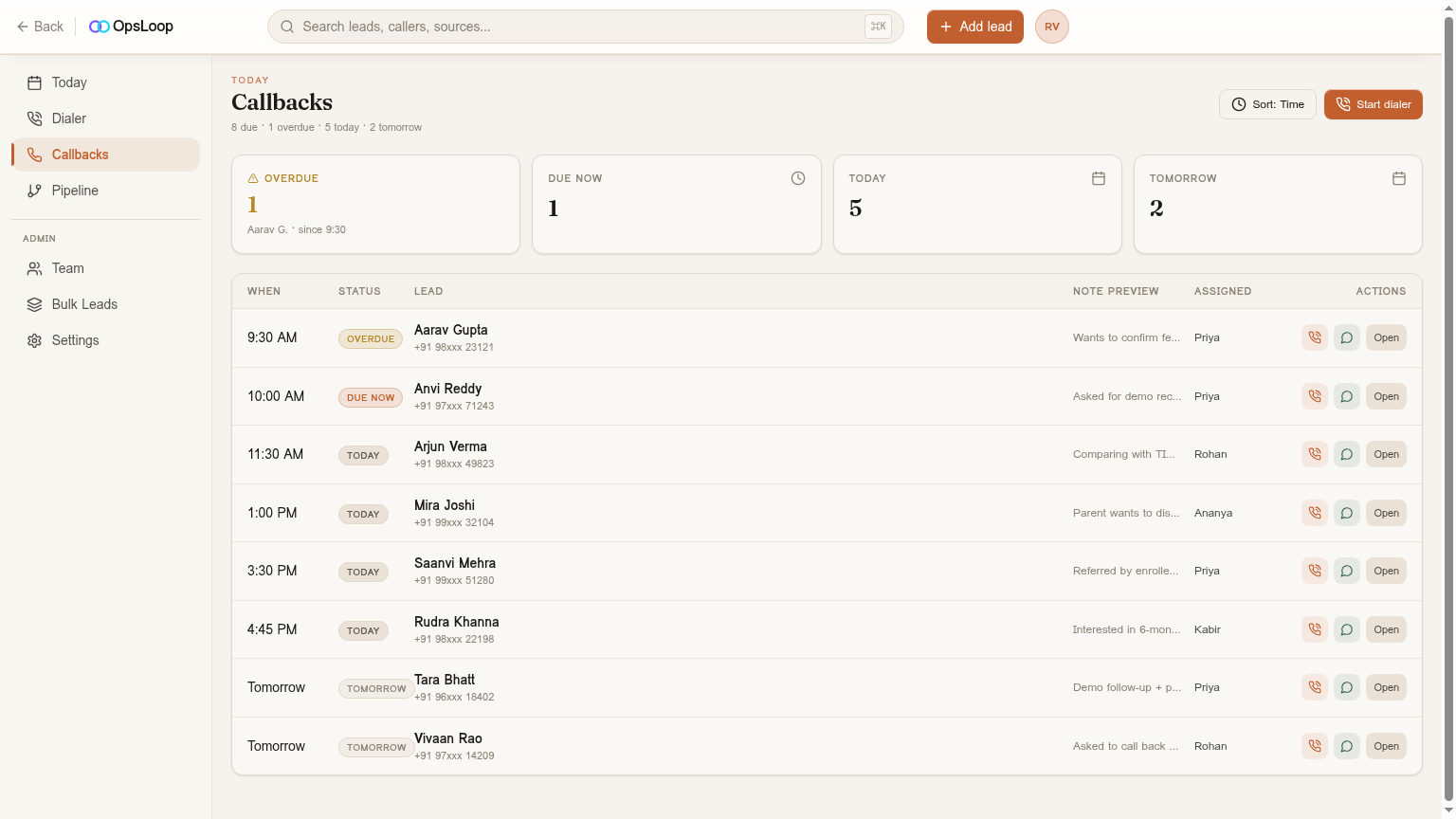
Manually sending timely and personalized WhatsApp follow-ups to every lead is nearly impossible for growing businesses. This is where a dedicated WhatsApp CRM platform like OpsLoop becomes invaluable. OpsLoop is a flat-rate CRM + WhatsApp lead-ops platform designed specifically for Indian businesses, ensuring you never miss a lead or a follow-up.
With OpsLoop, you can:
- Automate Sequences: Set up pre-approved WhatsApp template sequences that trigger automatically based on lead stage or actions. This ensures every lead gets a timely follow-up without manual effort.
- Maintain Context: All WhatsApp reply threads are linked to the lead's profile, giving your team full context of every conversation.
- One Inbox: Manage all your WhatsApp, email, and call communications in a single, unified inbox, preventing lead chaos.
- Leak Audit: OpsLoop's unique Leak Audit feature tells owners where pipeline is dying automatically, highlighting cold leads or missed callbacks, so you can intervene.
Automating your WhatsApp follow-ups means your team can focus on quality conversations, not repetitive messaging. Learn more about how to streamline your communication with automation in our guide on WhatsApp Automation for Business: Your Indian Playbook.
Common Mistakes to Avoid in WhatsApp Follow-Ups
Even with the best intentions, businesses often make mistakes that can turn customers off. Avoid these pitfalls:
-
Being Too Pushy or Salesy: WhatsApp is personal. A constant barrage of sales messages will lead to blocks. Focus on providing value and building a relationship.
-
Sending Long, Generic Messages: People skim. Keep it short, direct, and always personalized. Generic messages feel impersonal and are often ignored.
-
Ignoring Replies or Questions: If a customer replies, respond promptly and thoughtfully. Ignoring them defeats the purpose of a two-way communication channel.
-
Not Tracking Outcomes: Without knowing which messages work and which don't, you can't improve. Use a CRM to log interactions and track conversion rates.
-
Not Using a Dedicated Platform: Relying on personal WhatsApp numbers or shared inboxes leads to chaos, missed messages, and lack of accountability. A WhatsApp CRM is essential for professional lead management.
-
Inconsistent Follow-Up: Sending one message and then forgetting about the lead is as bad as no follow-up at all. A structured, consistent approach is key to nurturing leads over time. Many Indian SMBs leak 40% of their leads due to inconsistent follow-up.
Key Stats for Effective Follow-Ups
- Prompt Response Matters: Responding to leads within 5 minutes can increase conversion rates by 21x compared to responding in 30 minutes or more.
- Consistency Pays Off: Leads often require 5-7 touchpoints before converting. A structured follow-up sequence ensures these touchpoints happen.
- Higher Show-Up Rates: Businesses leveraging automated, personalized WhatsApp reminders see a +34% demo show-up rate, ensuring more prospects engage with your sales team.
Ready to Streamline Your WhatsApp Lead Ops?
Stop letting valuable leads slip through the cracks. OpsLoop helps Indian businesses, from coaching institutes to real estate agencies, manage their entire lead-to-sale journey with powerful WhatsApp automation and a flat-rate CRM. See how OpsLoop can help your business convert more enquiries and grow faster. For example, explore how we help businesses in real estate manage their leads effectively.
Further reading
FAQ
Frequently asked
Why is WhatsApp the best channel for follow-ups in India?
WhatsApp is India's most popular messaging app, ensuring high open rates and immediate engagement, making it ideal for quick, personal follow-ups with your customers.
How quickly should I send a WhatsApp follow-up after an enquiry?
The faster, the better. Aim for within minutes, ideally under 5 minutes, while the lead is still hot and interested in your product or service.
Can I automate WhatsApp follow-up messages?
Yes, with a WhatsApp CRM platform like OpsLoop, you can set up automated follow-up sequences using approved templates to ensure consistent and timely communication without manual effort.
What kind of content works best in a WhatsApp follow-up?
Short, personalized messages that offer value, answer potential questions, and guide the customer to the next logical step (e.g., booking a demo, sharing a brochure, confirming details).
How can I avoid sounding spammy on WhatsApp?
Personalize messages, respect customer privacy, avoid bulk blasting unrelated content, and ensure your messages provide genuine value. Always use approved templates for automated messages to maintain professionalism.
What's the biggest mistake businesses make with WhatsApp follow-ups?
The biggest mistake is inconsistency or no follow-up at all. Leads go cold quickly, and without a structured system, many potential customers are lost to competitors who are faster and more organized.
READ NEXT
WhatsApp Shared Team Inbox India: Your 2026 Guide
Boost your Indian business's lead response by 30% with a WhatsApp shared team inbox. Streamline communication, prevent l…
WhatsApp Conversation Pricing Meta 2026: Your India Guide
Understand Meta's WhatsApp conversation pricing for Indian businesses in 2026. Learn how 4 message categories impact cos…
WATI Pricing in India (2026): A Complete Guide for SMBs
Understand WATI's pricing in India for 2026, from its ₹4,100 base plan to per-message costs. Learn how to calculate tota…
Try OpsLoop free for 14 days
Flat team plans from ₹3,000/month. No per-seat fees. No card to start.