Telecalling CRM: Best Options for India (2026 Review)
Find the best telecalling CRM in India. Our 2026 review compares 7 top tools on flat vs. per-seat pricing to help your sales team convert more leads.


A great telecalling CRM for an Indian business does three things well: it makes calling fast with an auto-dialer, automates follow-ups on WhatsApp, and doesn't charge you more every time you hire a new caller. For most small and medium businesses, the best option is a flat-rate platform that combines all three without hidden costs. This approach ensures your software bill doesn't scale with your headcount.
Your sales team lives on the phone. Every minute wasted searching for numbers, manually logging calls, or forgetting callbacks is a lost opportunity. The right software fixes this by turning your lead list into a focused calling queue, making your team faster, more organized, and more effective. This guide reviews the top 7 telecalling CRMs available in India, focusing on the pricing models and features that matter most to a growing business.
How We Picked the Best Telecalling CRMs
We evaluated these tools based on four practical criteria for Indian businesses that rely on outbound calling to drive revenue.
1. Pricing Model: Flat-Rate vs. Per-Seat
This is the most important factor for a telecalling team. Per-seat pricing, common with tools like Zoho and LeadSquared, means your bill goes up with every new hire. For a 10-person calling team, a ₹2,500/user plan becomes ₹25,000 per month. Flat-rate pricing, offered by OpsLoop and Kylas, gives you a fixed monthly cost for unlimited users. This model supports growth instead of penalizing it. We've detailed the math behind flat-rate CRM pricing and why it's a better fit for operations-heavy businesses.
2. WhatsApp Integration Depth
In India, a call is almost always followed by a WhatsApp message with a brochure, payment link, or meeting confirmation. A good telecalling CRM doesn't just have a WhatsApp add-on; it has native, automated follow-up sequences. Can you trigger a 3-day message sequence automatically based on a call outcome? Is the entire chat history visible next to the lead's details? This is the difference between a useful tool and just another tab to manage.
3. India-Specific Features & Support
Your business runs on INR and files GST. Your software should too. We prioritized tools with INR pricing to avoid foreign exchange surprises from USD or EUR billing. We also looked for features relevant to the Indian market, like robust support for leads from sources like IndiaMART and Justdial, and local support teams that understand your challenges.
4. Time-to-Live (Setup Time)
As a business owner, you don't have six weeks for a complex software implementation. The best tools for SMBs are those you can get running in a day or two. We favoured platforms with pre-built industry templates and intuitive interfaces that a small team can adopt without needing a dedicated IT consultant.
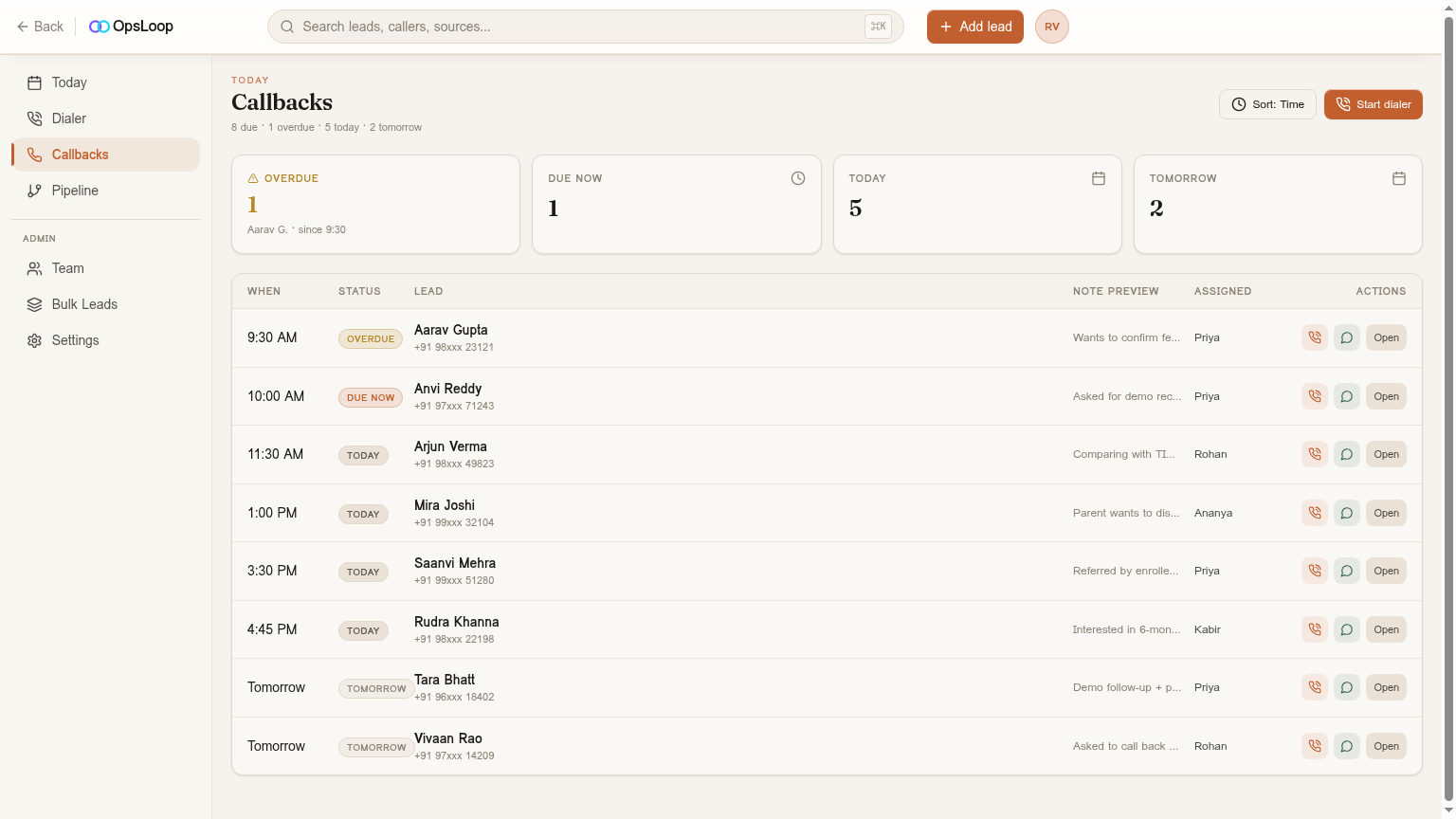
Telecalling CRM Comparison for India (2026)
| Tool | Starting Price (INR/mo) | Pricing Model | Best For |
|---|---|---|---|
| OpsLoop | ₹3,000 | Flat per team size (no per-seat fees) | SMBs (1-15+ callers) wanting an all-in-one dialer, WhatsApp, and CRM. |
| LeadSquared | ₹2,500 / user | Per-Seat | Larger teams and field sales operations needing deep customization. |
| Kylas | ₹12,999 | Flat (Unlimited Seats) | Mid-market companies (10-50 reps) needing a core CRM with optional add-ons. |
| Zoho CRM | ₹0 (for 3 users) | Per-Seat | Startups and small teams needing a free, feature-rich CRM to begin with. |
| HubSpot | ₹0 (unlimited users) | Hybrid (Free + Per-Seat) | Businesses needing a powerful free CRM but without native telecalling features. |
| Pipedrive | ~₹1,288 / user | Per-Seat (EUR Billing) | Sales teams that prioritize a clean, visual pipeline over an integrated dialer. |
| Salesforce Starter | ~₹2,250 / user | Per-Seat (USD Billing) | Businesses needing an enterprise-grade platform and ready for complexity. |
In-Depth Reviews of the Top 7 Telecalling CRMs
Here’s a detailed look at each platform, its real costs, and who it’s built for.
1. OpsLoop
(Disclosure: OpsLoop is our product. We've built it based on the challenges we saw firsthand in Indian SMBs and kept this review factual.)
OpsLoop is a flat-rate CRM and lead operations platform designed specifically for Indian businesses with high-volume sales calling. It combines a one-tap auto-dialer, automated WhatsApp follow-up sequences, and a visual sales pipeline in a single package with no per-user fees.
- Pricing: The model is simple and based on team-size bands. The Starter plan is ₹3,000/month (1–3 callers). The most popular Growth plan is ₹5,000/month (4–8 callers). The Scale plan is ₹6,999/month (9–15 callers). Enterprise is custom-quoted for 16+ callers. There's a ₹5,000 one-time setup fee. No per-seat fees: one price covers everyone in your team-size band.
- Strengths:
- Team-Size Pricing: Your calling team can grow from 4 to 8 people at ₹5,000/month, or up to 15 at ₹6,999/month, with no per-seat fees. This is its biggest advantage over per-seat competitors.
- Integrated Dialer & WhatsApp: The auto-dialer, call logging, and automated WhatsApp sequences are built-in, not expensive add-ons. This creates a seamless workflow for callers.
- Limitations:
- Not for Bulk Email Marketing: OpsLoop is designed for 1:1 sales communication (calls, WhatsApp, email threads), not for sending mass email newsletters.
- Sales-Focused: It's built for the lead-to-payment journey and is not a post-sale customer support or ticketing platform.
- Who it’s for: OpsLoop is the ideal choice for Indian coaching centres, EdTech companies, real estate agencies, and lending businesses with teams of 5 to 50 callers who need an affordable, all-in-one system that’s live in one day. Check out our flat-rate pricing plans.
2. LeadSquared
LeadSquared is a powerful, India-focused sales execution platform. It's built for high-velocity sales teams and offers deep features around lead distribution, workflow automation, and field sales tracking.
- Pricing: LeadSquared is priced per-user. The Sales Pro plan costs ₹2,500/user/month, and the Sales Super plan is ₹5,000/user/month (billed annually). There is no free tier, and GST is extra.
- Strengths:
- Strong Field Sales Features: Its mobile CRM is excellent, with features like geo-tracking and field agent check-ins, making it great for teams on the move.
- Highly Customizable: It's designed for complex sales processes with advanced automation rules, lead scoring, and territory management.
- Limitations:
- Expensive Per-Seat Model: The cost compounds quickly. A 10-person team on the Pro plan will cost ₹3,00,000 per year plus GST, making it expensive for SMBs.
- No Free Tier: You can't start small and grow into it; you have to commit to the per-user cost from day one.
- Who it’s for: LeadSquared is best for established businesses with 20+ member sales teams, particularly in sectors like finance, education, and healthcare, that need a robust, customizable platform and have the budget for per-user pricing.
3. Kylas
Kylas is another India-focused CRM that champions a flat-rate pricing model, making it an interesting alternative. It offers a core CRM with unlimited users and then charges for specific feature add-ons.
- Pricing: Kylas has a free Embark plan (limited to 1,000 records). Its main paid plan, Elevate, costs ₹12,999/month for unlimited users. However, key features are paid add-ons: Email Tracking (₹800/mo), BI & Analytics (₹5,000/mo), and Field Sales (₹400/user/mo).
- Strengths:
- Flat-Rate Core CRM: Like OpsLoop, it avoids per-seat pricing, offering unlimited users for a fixed price, which is excellent for scaling a telecalling team.
- India-Optimized: It’s built for the Indian market and understands the needs of local SMBs.
- Limitations:
- Cost Creep from Add-ons: While the base price is flat, the costs can add up quickly. Adding analytics and email tracking brings the monthly cost to nearly ₹19,000.
- High Entry Price for Small Teams: The jump from a limited free plan to a ₹12,999/month plan is steep for businesses with just a few callers.
- Who it’s for: Kylas is a good fit for mid-sized Indian businesses (10-50 employees) that have outgrown basic CRMs and need an unlimited-user platform, but they should carefully budget for the necessary add-ons.
4. Zoho CRM
Zoho CRM is one of the most popular CRMs in the world and has a strong presence in India. It's part of a massive ecosystem of business apps and is known for its feature depth and affordability at the entry level.
- Pricing: Zoho's main draw is its generous Free plan for up to 3 users. Paid plans are per-user, per-month (billed annually): Standard (₹1,300), Professional (₹2,100), and Enterprise (₹3,000). Monthly billing is about 20% higher.
- Strengths:
- Excellent Free Tier: The free-for-3-users plan is genuinely useful and provides a fantastic starting point for any new business.
- Deep Feature Set: As you move up the paid tiers, Zoho offers an incredible range of features, from sales automation to inventory management.
- Limitations:
- Per-User Pricing Scales Poorly: Once you cross 3 users, the costs start to climb. A 10-person team on the Professional plan costs ₹21,000 per month.
- Complexity and Setup Effort: The sheer number of features can be overwhelming. Getting Zoho configured perfectly for a telecalling workflow takes time and expertise.
- WhatsApp is not Native: Integrating WhatsApp for automated follow-ups requires third-party connectors, adding complexity and cost.
- Who it’s for: Zoho CRM is perfect for startups and small businesses with 1-3 sales staff who need a powerful, free CRM. It's also a good option for larger companies already invested in the Zoho ecosystem.
5. HubSpot
HubSpot is a global leader in the CRM space, famous for its user-friendly interface and its powerful free tools. It offers a comprehensive platform that includes marketing, sales, and service hubs.
- Pricing: HubSpot has a legendary Free plan with unlimited users and up to 1 million contacts. The paid Starter plan begins at around ₹1,800/seat/month. The jump to Professional and Enterprise tiers is significant, often running into tens of thousands per month.
- Strengths:
- Best-in-Class Free CRM: No other platform offers as much value for free. Unlimited users, contact management, email tracking, and basic pipelines make it an incredible starting point.
- Polished User Experience: The interface is clean, intuitive, and easy for new team members to learn.
- Limitations:
- USD Billing: All pricing is in US dollars, exposing Indian businesses to currency fluctuations. The price you pay can change month to month.
- Not a Telecalling Tool: HubSpot is not designed for high-volume outbound calling. It lacks a native auto-dialer, and key automation features are locked behind expensive paid tiers.
- Who it’s for: HubSpot is an excellent choice for businesses that are more marketing-focused (email, content, social media) and need a central place to manage contacts. It is not an ideal fit for dedicated telecalling teams who need speed and efficiency.
6. Pipedrive
Pipedrive is a CRM built by salespeople, for salespeople. Its entire interface is built around a visual sales pipeline, making it incredibly intuitive for tracking deals through stages.
- Pricing: Pipedrive is priced per-seat and billed in Euros. The Lite plan is ~₹1,288/seat/mo, Growth is ~₹3,588, and Premium is ~₹4,508 (annual billing). There is no free tier.
- Strengths:
- Exceptional Pipeline UX: The drag-and-drop pipeline is the core of the product and is a very effective way to visualize and manage your sales process.
- Sales-Focused: It doesn't try to be an all-in-one business suite. It focuses purely on sales activity management and does it well.
- Limitations:
- EUR Billing: Like HubSpot's USD pricing, the Euro billing creates budget uncertainty for Indian businesses.
- Features Locked in Higher Tiers: Critical automation and integration features are only available in the expensive Premium plans.
- Add-ons Increase Costs: Tools for lead generation (LeadBooster) are paid add-ons, further increasing the total cost.
- Who it’s for: Pipedrive is for sales teams who manage a smaller number of high-value deals and prioritize a visual pipeline above all else. It's less suited for high-volume telecalling operations.
7. Salesforce Starter
Salesforce is the undisputed global leader in CRM. The Starter Suite is their attempt to bundle their powerful platform into a more accessible package for small businesses.
- Pricing: The Starter Suite costs ~$25/user/month (around ₹2,250), billed annually in USD. This is their most affordable entry point.
- Strengths:
- Enterprise-Grade Power: You are buying into a platform known for its robustness, security, and limitless customization potential.
- Strong Reporting: Salesforce's reporting and dashboard capabilities are powerful, even in the starter edition.
- Limitations:
- Complexity: Even the 'Starter' version carries the DNA of an enterprise product. It can be complex to set up and manage for a small business without dedicated IT resources.
- USD Billing & Annual Contracts: You face currency risk and are typically locked into an annual commitment.
- High Total Cost of Ownership: Implementation often requires a certified consultant, adding significant cost beyond the license fee.
- Who it’s for: Salesforce Starter is for ambitious, well-funded startups or small businesses that plan to scale rapidly and want to build their operations on an enterprise-grade platform from day one.
Which Telecalling CRM Should You Pick?
Your choice depends on your team size, budget, and primary need.
-
If you are a solo founder or a team of 1-3: Start with the free plans from Zoho CRM or HubSpot. They are powerful, cost nothing, and will help you organize your initial leads. You will have to do your calling and WhatsApp follow-ups manually, but it's the right place to begin without any financial commitment.
-
If you are a growing business with a team of 5-25 callers: This is where the pricing model becomes critical. A per-seat CRM will start to cost you ₹15,000 - ₹50,000 per month. Your best choice is a flat-rate platform. OpsLoop (that's us) is built for this exact scenario, providing an integrated dialer, WhatsApp automation, and one predictable monthly fee per team size with no per-seat charges. It's designed to help you stop leaking expensive leads without punishing you for hiring more callers.
-
If you are a larger organization (25+ callers) or have field sales teams: Your needs are more complex. You likely require advanced customization, territory management, and detailed reporting. LeadSquared is an excellent, India-focused choice here. For those needing an enterprise-grade, globally recognized platform, Salesforce is the standard, provided you have the budget for licenses and implementation.
Get Your Calling on Track
Choosing a telecalling CRM isn't just about software; it's about building a system for growth. By focusing on a flat-rate pricing model and deep integration with WhatsApp, you can empower your team to call more effectively and close more deals without seeing your costs spiral out of control. Your ad spend is too valuable to waste on leads that are never called or followed up with properly.
Ready to see how a flat-rate, WhatsApp-integrated telecalling CRM can transform your sales process?
Further reading
FAQ
Frequently asked
What is a telecalling CRM?
A telecalling CRM is software designed for high-volume outbound calling. It combines standard lead management with features like one-tap auto-dialers, automatic call logging, callback scheduling, and performance tracking for calling agents.
Why is flat pricing important for telecalling teams?
Telecalling is a headcount-heavy function. Flat pricing is crucial because it allows you to add more callers to your team without increasing your software bill. Per-seat models directly penalize you for growing your team.
Do these CRMs include WhatsApp messaging costs?
It varies. Platforms like OpsLoop build WhatsApp follow-up sequences into their core product. Most other CRMs require integration with a separate WhatsApp Business API provider, which involves additional per-message charges from Meta (e.g., ~₹1.09 per marketing message).
How long does it take to set up a telecalling CRM?
It depends on the platform. Tools with pre-built industry templates like OpsLoop can be fully operational in one day. More complex, customizable CRMs like Salesforce or even a heavily modified Zoho can take weeks and may require a dedicated implementation partner.
Which is the best free telecalling CRM in India?
Zoho CRM and HubSpot offer the most generous free tiers, supporting up to 3 and unlimited users respectively. However, their free plans lack the dedicated telecalling features like auto-dialers and advanced automation found in paid tools.
Can I use my existing phone number with a telecalling CRM?
Yes, most telecalling CRMs use your existing infrastructure. Their auto-dialers typically work as a 'click-to-call' function from your computer or a mobile app, which then uses your phone's SIM or a connected cloud telephony service to place the call.
READ NEXT
WhatsApp Shared Team Inbox India: Your 2026 Guide
Boost your Indian business's lead response by 30% with a WhatsApp shared team inbox. Streamline communication, prevent l…
WhatsApp Conversation Pricing Meta 2026: Your India Guide
Understand Meta's WhatsApp conversation pricing for Indian businesses in 2026. Learn how 4 message categories impact cos…
WATI Pricing in India (2026): A Complete Guide for SMBs
Understand WATI's pricing in India for 2026, from its ₹4,100 base plan to per-message costs. Learn how to calculate tota…
Try OpsLoop free for 14 days
Flat team plans from ₹3,000/month. No per-seat fees. No card to start.